
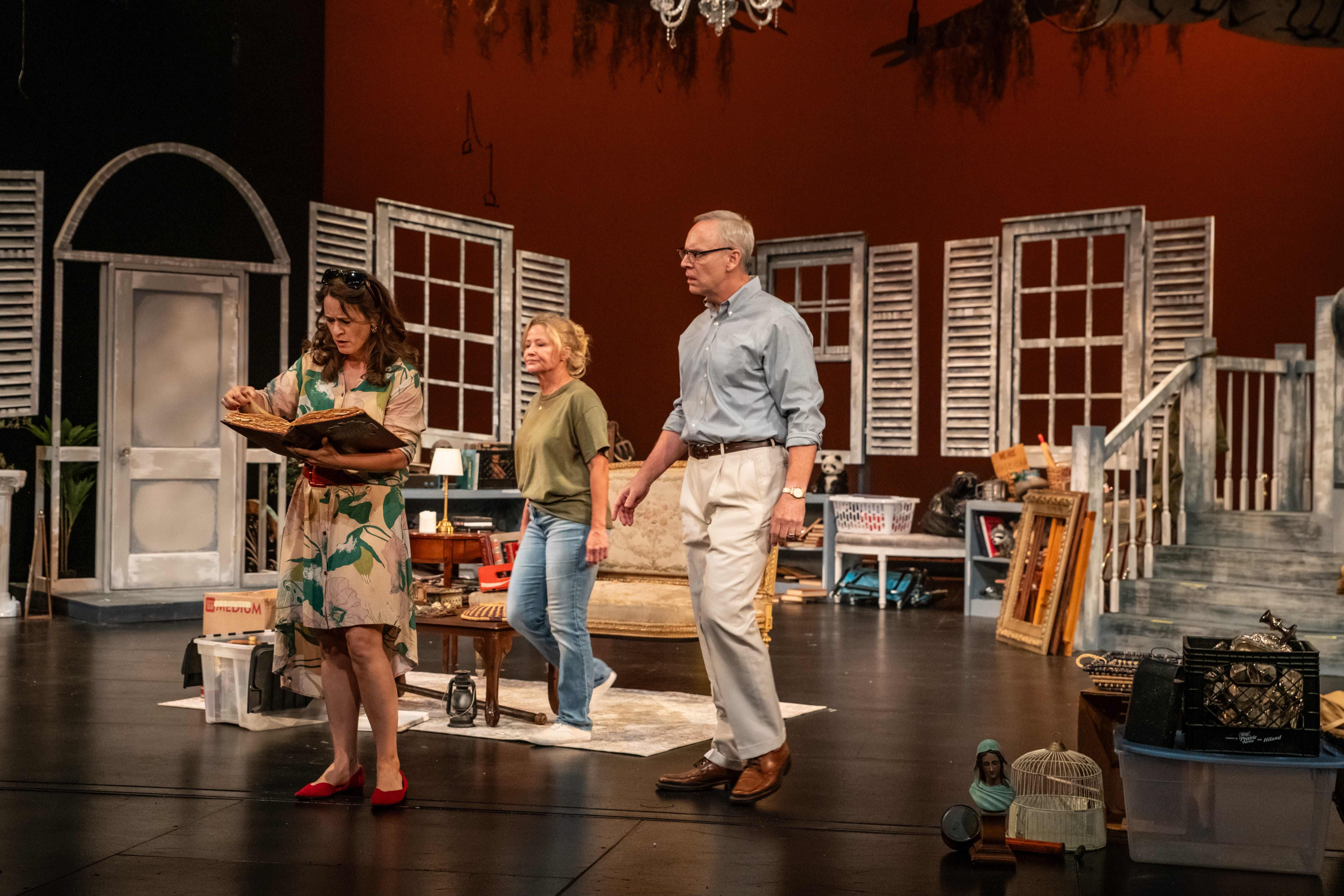
The Tennessee Williams St. Louis Festival opened on Friday evening with the St. Louis premiere of Branden Jacobs-Jenkins’ dark comedy Appropriate. This is the first year that the festival’s main stage production is a play written by a playwright other than Tennessee Williams.
This season’s festival theme “The Tennessee Effect” features the work of a writer whose works have been influenced by Tennessee William’s storytelling devices. In his program notes, renowned director Benny Sato Ambush points out a few of Williams’ signatures in Appropriate, and calls Jacobs-Jenkins’ play “a fitting tribute to Williams’ enduring impact.”
Appropriate is set in the cluttered living room of a Southwest Arkansas plantation following the death of the Lafayette’s family’s hoarding father. As his children sort through the clutter, they’re shocked by items they uncover pointing to the South’s deeply disturbing history of racism, oppression, and murder.
Scenic and lighting designer Matthew McCarthy and properties designer Mikhail Lynn have collaborated to bring the framework of a cluttered ground floor living space of a hoarder’s mansion. The off-kilter windows, flanked by damaged plantation shutters, show the poor condition of the home the Lafayette children have inherited. The overhead moss draped tree limbs become an integral part of the storytelling as audience perspective shifts and the overhead imagery becomes what the designer calls “perceptible art.” Lynn has a heavy lift, pun intended, with the large number of props required by the production to present a realistic depiction of a hoarder’s space.
McCarthy and Lynn’s work is complimented by Mary Robinson’s environmental realism. The constantly present cicada songs create an audible unease, with trilling more pronounced in evening hours than during the daytime. Robinson’s sound design creates a believable representation of nature noises native to rural Arkansas in the mid-late summer.
When the play opens, the eldest Lafayette daughter and estate executor Toni (Jilanne Marie Klaus) and her teenage son Rhys (Braden Phillips) await the arrival of her younger sibling Bo (Michael James Reed), his wife Rachel (Lizi Watt), and their children, 13-year-old Cassidy (Ainsley Hammond), and 10-year-old Ainsley (Aviv Giancola-Poremba). Toni and Rhys are surprised when her estranged brother Frank (Joel Moses) shows up unexpectedly accompanied by his much younger girlfriend River (Maggie Newstead-Adams). Frank has a long history of addiction and legal issues. He’d disappeared for more than a decade but turns up as the family attempts to settle the father’s estate.
The dysfunctional reunion, with Frank as the common enemy, quickly shifts to an all-out argumentative and physical melee between the siblings and their significant others with the children caught in the crossfire. Director Benny Sato Ambush and fight director Shaun Sheley have blocked realistic physicality to match the volatility of the actors’ portrayals.
Michael James Reed gives the standout performance as Bo, the middle child who is heavily invested in the father’s real estate. Reed’s conveys Bo’s financial desperation supported by an emotive portrayal with authentic and explosive breakdowns that escalate into an overwhelming emotional crescendo.
Joel Moses paints the fragile Frank as a with visceral intensity. Moses wrestles with Frank’s vulnerabilities and gives the character a despondent anguish. Frank feels buried under his past and Moses’ portrayal feels like a man clawing for vindication and survival.
Eldest sibling Toni feels left on an island. Jilanne Marie Klaus is taxed with painting a strong, in-control character who is grappling with the worthless estate and residual anger directed at her father, brothers, and sister-in-law. Klaus’ portrayal gives Toni a too soft edge that doesn’t match the agonizing intensity of Reed and Moses’ characterizations. There were times her controlled portrayal lacked the needed sharpness and resentment. Klaus’ work seemed under rehearsed as she stumbled delivering parts of the dialogue, and it never felt as though Klaus gave herself the freedom to play the role with complete abandon.
The always dependable Lizi Watt puts Rachel on a slow simmer that eventually combusts into full boil. The one exception taken with Jacobs-Jenkins’ script is the language chosen for Rachel’s second act rant directed toward her sister-in-law. While the scripted dialogue is shocking and incendiary, her crude description of Toni seems out of character for the more refined Rachel.
Ainsley Hammond and Braden Phillips do a mostly convincing job aging down into their teenage roles. Hammond captures Cassidy’s premature adulthood and her pseudo-maturity. Phillips is emotive and strong when he’s involved in scene work with other characters, but his ensemble presence looks awkward when he’s on stage and not actively involved in the scene.
Aviv Giancarlo-Poremba holds her own in a talented cast while playing against gender as Bo and Rachel’s 10-year-old son. Maggie Newstead-Adams is strong in her supporting role as Frank’s emotionally stable girlfriend. She is an appeaser who convincingly loses control when her world is rocked by Frank’s truths.
Director Benny Ambush Sato has staged an exceptionally entertaining production of Branden Jacobs-Jenkin’s deeply disturbing play. Sato and his company fearlessly lean into themes of dysfunction, greed, racism, and denial. The propulsive, tightly paced production seems substantially shorter than its 2-hour and 45-minute run time. Appropriate is engrossing theater that uses dark comedy to tell of the horrors of racially motivated lynchings.
Appropriate continues as part of the Tennessee Williams’ Festival St. Louis through September 27, 2026. Visit twstl.org for more information and tickets to all festival events.